Direct lines of communication, quick turnaround

10 July 2026
Sprayer cans may seem harmless, but in large quantities they pose a serious risk. How do companies deal with the storage of thousands of pallets full of flammable products? A pragmatic and safe solution has been found on the Maasvlakte.
We all face this every day, both at work and in our private lives: hazardous substances. We don’t always think about it, but when you use your deodorant spray bottle, you are already “working” with hazardous substances. The contents, the propellant or the liquid are often flammable. That one can of spray won’t have as much effect as it exploding in flames. But where that storage of deodorant spray bottles takes place, other dangers lurk around the corner.
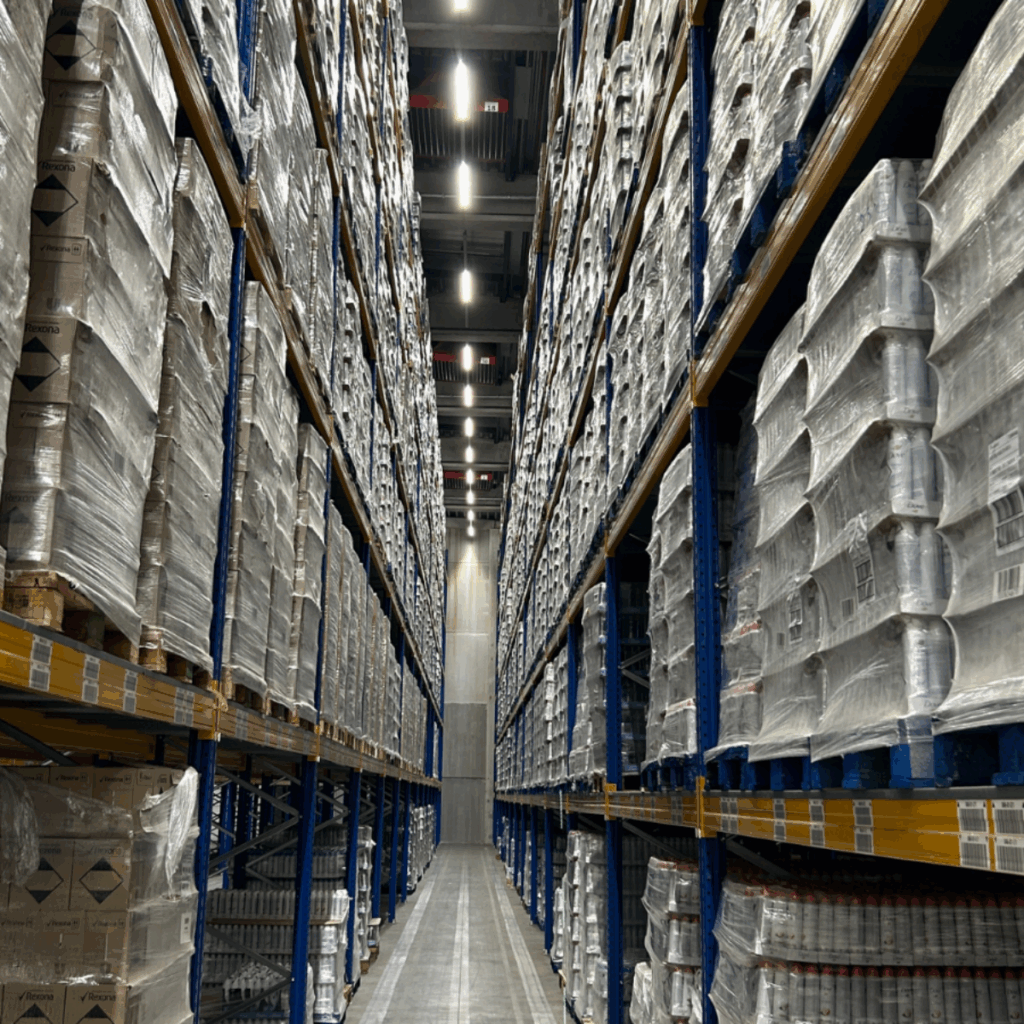
Buro Antares/Ekosafe has a client on the Rotterdam Maasvlakte that operates in warehouses on an area of approximately 7,500 m². It stores about 15,000 pallets of only spray cans of deodorant. Together, that is a small 9,000 tons of hazardous material. Then you’re talking about serious risks and the consequences for the environment if there is a fire. Incidentally, we are already spraying all that hazardous material “into the environment”, a huge amount, especially considering that the throughput in the warehouses is 3x to 4x per year.
The effect of a burning spray can is the ‘rocketing’ of the bus: the bus shoots through the space (becomes a projectile) and ignites other goods or cartons that are stored. Before you know it, the entire warehouse is ablaze from front to back. Of course, this is an undesirable situation that must be avoided.
The fire department would like every pallet to be placed in a cage. That is the standard rule in guidelines. This prevents the risk of a burning spray can being thrown into the air. A customer has rented a warehouse where a permit exists, with the obligation that spray cans must be stored in a steel cage or behind a wire fence. Operationally, this is of course a very challenging and highly costly task. When picking orders, they want to pick up a pallet and set it down without first removing all the barriers and also close the cage again after the order has been collected.
Through a risk analysis, we were able to demonstrate that storing spray cans without cages does not entail any additional risk. The warehouse in question has a gas extinguishing system. This means that when a fire is detected or even just a hint of smoke in the warehouse, within 30 seconds a fire extinguishing system is activated, the warehouse is completely filled with extinguishing gas (carbon dioxide), oxygen is expelled, and the fire is extinguished.
If a spray can should nevertheless leak, it is sealed off because the storage room is completely filled with extinguishing gas in no time at all. The customer can now store pallets of spray cans without any special equipment, which saves on investment in resources (chambers). This is certainly a major advantage in terms of operational efficiency, allowing for quick work.
In addition, the permit stipulated that fire extinguishers must be installed in each storage room. This is a standard requirement (“always attach them to the permit”). Due to the rapid detection and the automatic working extinguishing system, a hand-held extinguisher will never be used. Moreover, immediate evacuation is required in the event of a fire alarm because carbon dioxide is a toxic gas and the storage room is very cold (up to -50 °C) is caused by the rapid expansion of the gas.
Based on arguments, we were able to arrange that the availability of the fire extinguishers was no longer required (savings: over 50 extinguishers at €120 each + annual maintenance!). Through this procedure, we were able to change the permit to legalize the changed procedure. A nice boost and a favorable development for this company in the Rotterdam port.